
Here are some of the basic laws pertaining to affixing a Mezuzah.
If you have any specific questions, please consult your local Rabbi.
 Mezuzot are necessary for all of the doorways or entranceways
of each room, whether for the home or business, either owned or rented. An entranceway is defined
as having the shape of a doorframe on the right side as you enter and a lintel over head. Rooms
having an entrance made of walls leading straight up to the ceiling are exempt from mezuzah. (See Fig. B)
The entrance to the hallway that leads to a room
requires a Mezuzah even if the hall is less than minimum size. Other rooms which require
Mezuzos may include attics, balconies, basements, garages, laundry rooms, storage or utility rooms,
walk-in closets, etc.(excluding bathrooms)
Once a Mezuzah is put up, it must remain up! Even if the
occupants move to another apartment, they must leave the Mezuzos on, unless they know that the
newcomers are non-Jews. Outside of Israel unless you are in an exclusive Jewish area if you do
not know who will be the next renter one may remove the mezuzos
Mezuzot are necessary for all of the doorways or entranceways
of each room, whether for the home or business, either owned or rented. An entranceway is defined
as having the shape of a doorframe on the right side as you enter and a lintel over head. Rooms
having an entrance made of walls leading straight up to the ceiling are exempt from mezuzah. (See Fig. B)
The entrance to the hallway that leads to a room
requires a Mezuzah even if the hall is less than minimum size. Other rooms which require
Mezuzos may include attics, balconies, basements, garages, laundry rooms, storage or utility rooms,
walk-in closets, etc.(excluding bathrooms)
Once a Mezuzah is put up, it must remain up! Even if the
occupants move to another apartment, they must leave the Mezuzos on, unless they know that the
newcomers are non-Jews. Outside of Israel unless you are in an exclusive Jewish area if you do
not know who will be the next renter one may remove the mezuzos
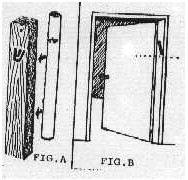 The Mezuzah should be rolled with care from the left side
to the right so that the letters
The Mezuzah should be rolled with care from the left side
to the right so that the letters  are showing on the
outside and then wrapped in wax paper. It should then be placed into the case so that the letters are
facing outside, and on the top.(See Fig. A)
The case should be affixed to the right side of the
door post. It should be on the first or most exterior part of the passageway and not in the
middle or even on the wooden part of the frame if the door is inside the passageway (on the
right side of the "entrance" of the room). The Mezuzah should be placed on the lowest part
of the upper third of the doorway and not higher than 4 inches from the top The Ashkenazic
custom is to place it on an angle slanted top-sided inwardly. (See Fig. B) The Sefardic custom
is to place it upright.
The Mezuzah must be firmly affixed! In case you cannot use
screws or nails, use a permanent bond glue, epoxy, or silicon. Most Rabbinical authorities permit
the use of mounting double sided tape, however do not allow the usage of "Scotch or cello tape"
Please consult your Rabbi concerning the use of "Bluetak" tape.
One Bracha is sufficient for all Mezuzot that are put up at one time.
One should not talk, from the time the Bracha is made, until the last Mezuzah is firmly affixed.
It is preferable to make the Bracha on the Mezuzah used for the main entrance.
A Bracha is said only when affixing a mezuzah onto a
home where the room both is a minimum size of 8' by 8' and has a doorway with a door. A
room in a home that does not meet these requirements for a Bracha still needs a mezuza.
A Bracha is not said on a non-residential property such as a store or office even though
a mezuzah is required.
If you put back the same Mezuzah on the same day it was removed, a Bracha should not be made, unless this Mezuzah was found to be invalid and was repaired.
are showing on the
outside and then wrapped in wax paper. It should then be placed into the case so that the letters are
facing outside, and on the top.(See Fig. A)
The case should be affixed to the right side of the
door post. It should be on the first or most exterior part of the passageway and not in the
middle or even on the wooden part of the frame if the door is inside the passageway (on the
right side of the "entrance" of the room). The Mezuzah should be placed on the lowest part
of the upper third of the doorway and not higher than 4 inches from the top The Ashkenazic
custom is to place it on an angle slanted top-sided inwardly. (See Fig. B) The Sefardic custom
is to place it upright.
The Mezuzah must be firmly affixed! In case you cannot use
screws or nails, use a permanent bond glue, epoxy, or silicon. Most Rabbinical authorities permit
the use of mounting double sided tape, however do not allow the usage of "Scotch or cello tape"
Please consult your Rabbi concerning the use of "Bluetak" tape.
One Bracha is sufficient for all Mezuzot that are put up at one time.
One should not talk, from the time the Bracha is made, until the last Mezuzah is firmly affixed.
It is preferable to make the Bracha on the Mezuzah used for the main entrance.
A Bracha is said only when affixing a mezuzah onto a
home where the room both is a minimum size of 8' by 8' and has a doorway with a door. A
room in a home that does not meet these requirements for a Bracha still needs a mezuza.
A Bracha is not said on a non-residential property such as a store or office even though
a mezuzah is required.
If you put back the same Mezuzah on the same day it was removed, a Bracha should not be made, unless this Mezuzah was found to be invalid and was repaired.
Before affixing the Mezuzah, the following Bracha should be made:

Sefardic transliteration: "Baruch atah adonai eloheinu melech ha-olam asher kideshanu b'-mitzvotav ve-tzivanu likboah mezuzah."
Ashkenazi transliteration: "Boruch ato adonoi eloheinu melech ho-olam asher kideshanu b'-mitzvosov ve-tzivonu likboah mezuzah."
Blessed are You, G~d, our G~d, King of the universe, Who has sanctified us with his mitzvot, and commanded us to affix the mezuza.
www.hasofer.com Email: mezuzot@hasofer.com